
I paint to translate what cannot yet be said
A sketch, a sound, a symptom all ask for a new language. I learned this in a senior home, where words often failed the people I was trying to help. On paper, I began to build another form of speech: a window breaking open, a hand reaching through water, a quiet warmth between a girl and a cat. Each image became a translation of pain into pattern, uncertainty into rhythm.
I am drawn to systems, neurological, linguistic, and visual, and to how they can become human. In the lab I model seizures in fruit flies. On canvas, I trace how emotion moves through space and color. Both are experiments in translation. I build images the way I build protocols: define variables, test, revise, keep what tells the truth. Painting, like research, gives shape to empathy. It turns confusion into something you can read.
In this acrylic painting, a girl is trapped in a glass bottle, half drowning in the water as she reaches up towards her only glimmer of light. The moon, shining like her hopes and dreams. The colossal hands represent a multitude of societal influences, trying to shake up the girl’s fragile bottle of life. Represent the dilemma of many students between chasing their dreams and passions and doing well in school and satisfying their parents expectations. Swirling streaks of blue, green, and yellow also intensify a sense of mystery and almost like a portal.


I chose to use sketching for the first painting since the monochrome colors would be able to convey the sombre tones better. The painting depicts a young girl who’s world has just fallen apart, exploding behind her in the form of the window. Scattered across the room lie many items that have led up to this moment: a divorce paper, her mother’s high heels, schoolbooks, a broken and vandalized portrait of her once-happy family, and an empty wine bottle. In the center of the room, the girl clutches onto a teddy bear from her childhood, a time where everything was okay. The windows I designed to be disproportionately bigger to give off a sense of the girl curling up to become as small as possible.

I wanted light to feel measurable, the way breath feels after concentration. A woman lifts her hat by the water; the body eases while the surface keeps a gentle pulse. Boats blur into the distance so the horizon hums instead of shouting. I layered the skirt until the wind read like time. This is not a scene about leisure. It is a study of recovery, when rhythm returns to a tired mind. Painting it reminded me that rest is part of the method, and that clarity can arrive quietly and still be complete.
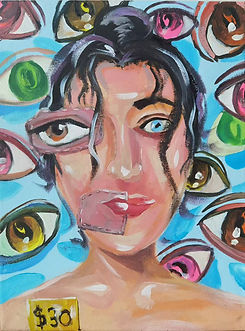
This portrait started as a study of perception and ended up as a note to myself about honesty. The eyes circle the face because attention never lands in one place for long. The sewn mouth records what I am not ready to say. I kept the skin tones quiet so the mind could speak first. The fractures are not decoration; they map where thought changes direction. I want the viewer to feel the split second when recognition arrives, the moment before language catches up. For me, the picture is a rehearsal for empathy, an organized way to listen.

This landscape began as practice in patience. I laid down small strokes until the sea found a pulse that felt true. The cliffs keep their shape while the water keeps changing, which matches how most systems behave. I kept the palette restrained so light could carry the story. What interests me here is not scenery but behavior: how repetition reveals difference, how pattern becomes comprehension. It felt like a slow experiment—repeat, observe, keep what tells the truth. The piece taught me that persistence can be a form of care.
Visual Art


